Is your indoor cat sleeping all day, staring out the window, or looking for something to do? Many indoor cats need more than food, a litter box, and a comfortable bed. They also need opportunities to play, explore, climb, scratch, hunt, and use their minds.
These indoor cat enrichment ideas can help turn an ordinary home into a more interesting and stimulating environment. The good news is that enrichment does not have to be expensive. Simple toys, cardboard boxes, food puzzles, window perches, climbing spaces, and short play sessions can make a meaningful difference.
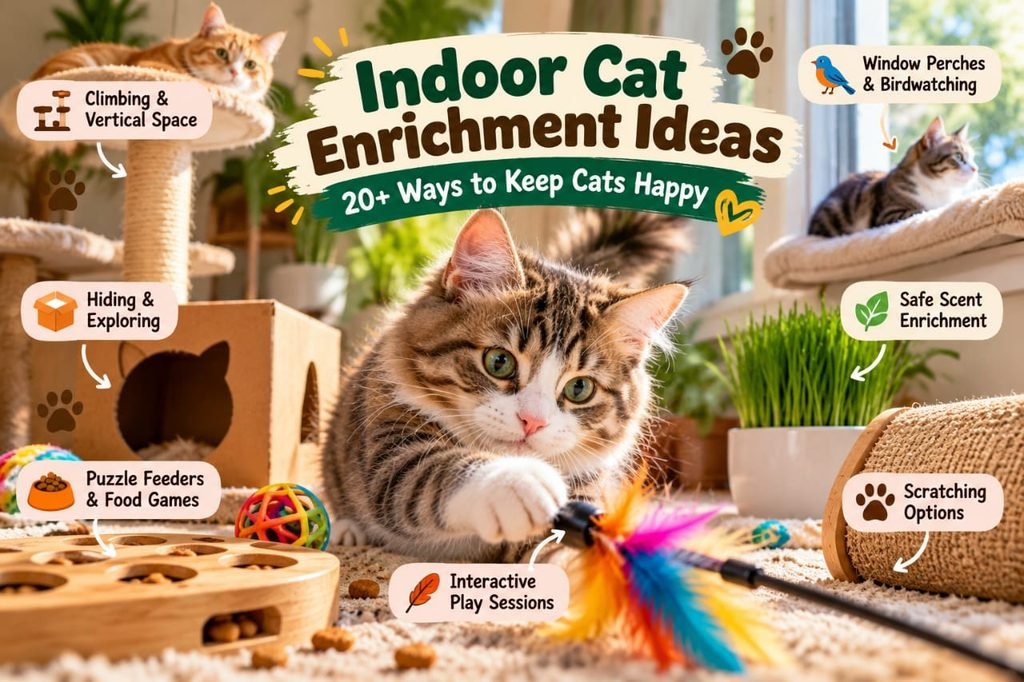
Whether you have a playful kitten, an adult cat, or a senior companion, the key is to provide activities that match your cat’s personality, age, and abilities. In this guide, you’ll discover practical indoor cat activities that can help reduce boredom, encourage healthy movement, and strengthen the bond between you and your cat.
Indoor living protects cats from many outdoor dangers, including traffic, fights, predators, and exposure to some infectious diseases. However, an indoor lifestyle can become predictable if a cat has very few opportunities to play, explore, or make choices.
Environmental enrichment gives cats appropriate ways to express natural behaviors. Instead of simply adding more toys, the goal is to create opportunities for movement, exploration, problem-solving, scratching, hiding, resting, and interaction.
Regular enrichment can also make daily life more interesting. A few minutes of interactive play in the morning, a food puzzle at lunchtime, and a window perch in the afternoon can provide variety without requiring hours of work.
Every cat is different. Some cats love chasing toys, while others prefer watching birds from a window or exploring cardboard boxes. Pay attention to what your cat enjoys and build enrichment around those preferences.
Before choosing enrichment activities, it helps to understand the behaviors cats naturally enjoy. Cats often like to stalk, chase, pounce, climb, scratch, hide, observe, and investigate new environments.
Good cat enrichment for indoor cats should therefore include different types of stimulation rather than relying on one toy.
The best enrichment program combines several of these needs while allowing your cat to choose whether to participate.
Interactive play is one of the simplest and most effective indoor cat enrichment ideas. Instead of leaving a toy on the floor, actively move an appropriate toy so your cat can stalk, chase, and pounce.
Wand toys and feather-style toys can be useful for interactive play. Move them like prey rather than waving them constantly in front of your cat. Let the toy disappear behind furniture, move slowly, then suddenly change direction.
Short sessions are often enough. Try several brief play sessions throughout the day rather than expecting your cat to play for a long period at once.
Allow your cat to catch the toy occasionally. Finishing a play session with a successful “capture” can make the activity more satisfying.
Never leave string, ribbon, or similar toys with a cat unsupervised. Put them away after interactive play.
Food can become an opportunity for mental stimulation instead of simply being placed in a bowl.
Puzzle feeders and food-dispensing toys can encourage cats to work for some of their food. Start with an easy puzzle and gradually increase the challenge if your cat enjoys it.
You can also hide small portions of your cat’s normal food in several safe locations around the home. This encourages exploration and foraging.
Remember to account for treats and food used in enrichment when considering your cat’s overall daily intake. If your cat has a medical condition or a special diet, ask your veterinarian before changing their feeding routine.
Many cats enjoy being able to climb and observe their surroundings from an elevated position. Vertical space can be especially useful in smaller homes where floor space is limited.
A sturdy cat tree is one option. You can also use appropriately secured shelves designed to support your cat’s weight.
Create different levels where your cat can climb, rest, and observe. Make sure every climbing structure is stable and cannot easily tip over.
In homes with several cats, multiple elevated resting areas can also give individual cats more choices and opportunities to move away from each other when they want space.
A window can provide hours of visual stimulation. Birds, trees, people, weather, and other outdoor activity can give an indoor cat something interesting to observe.
A secure window perch can create a comfortable viewing area. Place it somewhere your cat already enjoys spending time, if possible.
Always make sure windows are properly secured. Do not allow your cat access to an unsafe open window, balcony, or other location where they could fall or escape.
If your cat enjoys watching birds, a safe outdoor viewing area can provide additional stimulation. The priority should always be keeping the cat safely indoors.
You do not need to spend a lot of money to make your cat’s environment more interesting. Many simple household materials can become temporary enrichment items.
A simple cardboard box can become a hiding place, tunnel, or exploration area. Add a few large openings and place it somewhere your cat can safely investigate.
An ordinary paper bag can provide a fun hiding and exploration opportunity. Remove handles before giving it to your cat and supervise its use.
Clean cardboard tubes can be incorporated into simple food puzzles. Always supervise your cat and remove the object if it becomes damaged or if your cat begins chewing pieces from it.
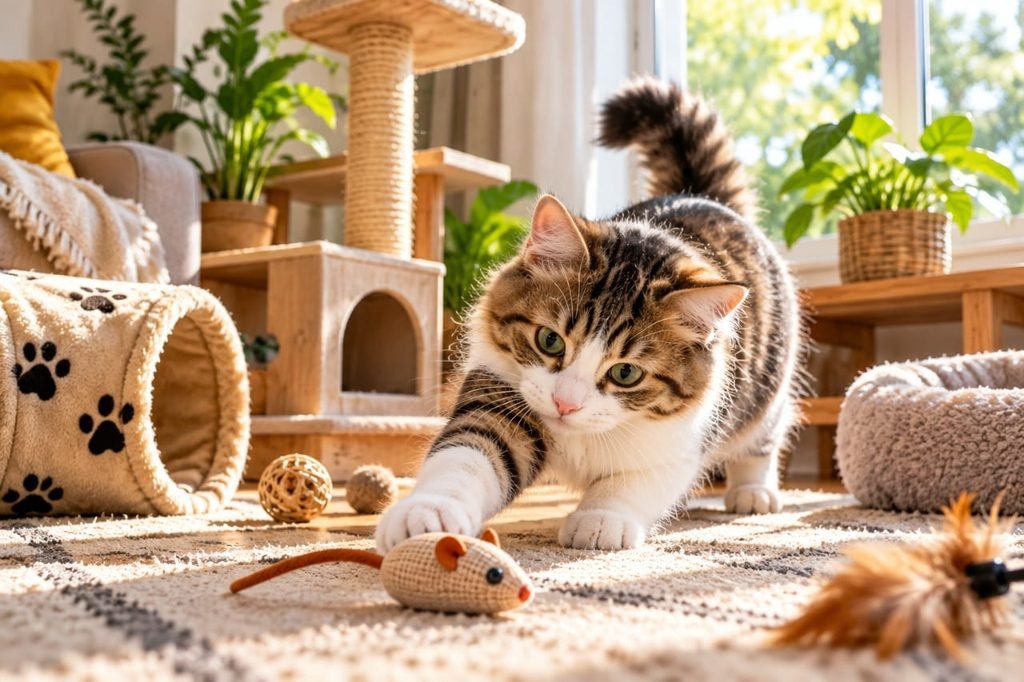
A blanket placed over part of a sturdy piece of furniture can create a simple hiding area. Cats often appreciate having both open resting spaces and private hiding places.
DIY enrichment should always be supervised, especially when introducing a new object.
Scratching is a normal cat behavior. It helps cats stretch, maintain their claws, and communicate through scent and visual marks.
Instead of trying to stop scratching completely, provide appropriate places where your cat can scratch.
Place scratching options near areas where your cat already likes to scratch. You can also put one near a favorite sleeping area because some cats enjoy stretching and scratching after waking.
Training is an excellent way to provide mental stimulation for cats. Cats can learn behaviors using positive reinforcement, especially when training sessions are short and rewarding.
You can teach behaviors such as coming when called, touching a target, sitting, or entering a carrier voluntarily.
Use small rewards and keep sessions brief. Stop while your cat is still interested rather than continuing until they become frustrated.
Never punish your cat for failing to perform a behavior. Positive reinforcement helps make training a rewarding experience.
Smell is an important part of a cat’s environment. New but safe scents can provide additional sensory stimulation.
Some cats respond to catnip or silvervine, while others show little interest. Introduce new scent-based enrichment in small amounts and observe how your cat reacts.
Avoid assuming that something is safe simply because it is natural. Essential oils and concentrated fragrances can pose risks to cats, so they should not be used as casual cat enrichment.
If you are unsure about a particular plant, herb, fragrance, or product, ask your veterinarian before introducing it into your cat’s environment.
Some indoor cats enjoy experiencing outdoor sights and smells without being allowed to roam freely.
Depending on your circumstances, options can include supervised harness training or a properly enclosed outdoor space such as a secure catio.
Harness training should be introduced gradually. Some cats dislike wearing a harness, and they should not be forced into outdoor activities.
If you use a balcony or enclosed outdoor structure, make sure it is genuinely escape-proof and designed with your cat’s safety in mind.
Living with several cats can create additional enrichment opportunities, but it can also create competition for resources.
Provide multiple food and water areas, resting locations, scratching surfaces, hiding places, and litter boxes according to the needs of your household.
Do not assume that cats will always want to share. Some cats prefer individual spaces where they can rest without being disturbed.
Give each cat individual attention when possible. Short one-on-one play sessions can help you understand what each cat prefers.
One of the easiest ways to improve indoor cat activities is to rotate them instead of leaving every toy available all the time.
Keep some toys stored away and bring them back later. A toy that seemed boring last week may become interesting again after some time away.
You can also rotate the location of scratching posts, resting areas, or puzzle feeders when appropriate.
Do not change everything at once. Cats often appreciate predictable routines, so introduce changes gradually.
Older cats still need mental stimulation, but their physical abilities may change with age.
Choose activities that match their mobility. Gentle interactive toys, easy-access resting areas, simple food puzzles, and comfortable window perches can all provide enrichment.
Make sure food, water, litter boxes, and favorite resting areas are easy to reach.
If an older cat suddenly stops playing, becomes less active, or shows a significant change in behavior, speak with a veterinarian rather than assuming the change is simply due to aging.
Technology can provide another source of stimulation. Some cats enjoy watching videos featuring birds, fish, or other moving objects.
Automatic toys and treat-dispensing devices can also provide short periods of activity when you are busy.
However, technology should complement rather than replace human interaction. Your cat still benefits from play, attention, observation, and a predictable relationship with you.
Always supervise new electronic toys initially and remove anything that becomes damaged or creates a safety concern.
One of the best ways to make enrichment consistent is to build it into your normal routine.
You do not need to spend hours entertaining your cat. Small activities throughout the day can add up.
The ideal routine depends on your cat. Some cats need more activity, while others prefer shorter sessions and more quiet time.
You do not need a large house to provide excellent enrichment. In a small apartment, think vertically.
Use sturdy cat furniture, window perches, scratching posts, hiding areas, and puzzle feeders to make better use of the available space.
Rotate activities rather than filling the entire room with toys. A small number of carefully selected enrichment options can be more useful than a crowded environment.
Make sure pathways remain clear and that furniture or climbing structures cannot fall over.
Every cat has different habits, so one behavior alone does not necessarily mean your cat is bored. However, changes in behavior can be worth paying attention to.
Possible signs that your cat needs more appropriate stimulation may include:
Behavior changes can also have medical or emotional causes. If a behavior is sudden, severe, or unusual for your cat, consult your veterinarian.
Safety should always come before entertainment. Before introducing a new enrichment activity, consider whether your cat could swallow, become trapped by, or injure themselves with the object.
Remember that enrichment should never force a cat into an activity. Give your cat choices and allow them to walk away.
There is no single schedule that works for every cat, but rotating some toys regularly can help maintain interest. Keep a few favorites available and put other toys away temporarily before bringing them back later.
High-energy cats often enjoy interactive chase games, climbing structures, food puzzles, and short training sessions. Several brief play sessions throughout the day may work better than one very long session.
Yes. Indoor cats can have fulfilling lives when their physical, mental, social, and environmental needs are met. Providing appropriate opportunities to play, explore, climb, scratch, forage, and rest can make an indoor environment much more stimulating.
Create a safe environment with resting areas, window views, appropriate toys, scratching surfaces, and food puzzles. When you return home, spend time interacting directly with your cat through play or other activities they enjoy.
Use vertical space, window perches, scratching posts, cardboard boxes, puzzle feeders, and rotating toys. You can provide many forms of enrichment without having a large amount of floor space.
Regular interactive play is beneficial for many cats. The ideal amount depends on the individual cat’s age, health, energy level, and preferences. Several short sessions can be a practical starting point.
Not every cat responds to catnip, and individual reactions can vary. If you use catnip, introduce a small amount and observe your cat. If you have concerns about a particular product or your cat’s reaction, consult your veterinarian.
Absolutely. Senior cats can benefit from gentle play, comfortable resting areas, easy food puzzles, scratching opportunities, and safe places to observe their surroundings. Activities should be adjusted to their mobility and comfort.
Watch your cat’s body language and behavior. A cat that voluntarily approaches, plays, explores, or returns to an activity is showing interest. If your cat repeatedly avoids an activity or appears stressed, remove it and try something different.
Yes. Cardboard boxes, paper bags with handles removed, cardboard tubes, and other simple materials can become enrichment tools when used appropriately. Always supervise homemade activities and remove anything that becomes damaged.
Yes. Cats need opportunities for activity as well as quiet rest. If your cat appears stressed, frightened, or frustrated, stop the activity and allow them to retreat to a safe space.
The best indoor cat enrichment ideas do not have to be complicated or expensive. A combination of interactive play, food puzzles, vertical space, scratching areas, window views, safe hiding places, training, and toy rotation can make a home much more engaging for a cat.
The most important thing is to understand your individual cat. Some cats love chasing toys, others prefer climbing, watching birds, solving food puzzles, or exploring cardboard boxes. Observe what makes your cat curious and build more of those opportunities into their daily routine.
Enrichment is not about keeping your cat busy every minute of the day. It is about creating a safe environment where your cat can exercise natural behaviors, make choices, explore, play, and rest comfortably.
With a little creativity and consistency, your home can become a stimulating and rewarding environment for your indoor cat.


Leave a comment